
What Is a Starter Motor and How Does It Work? (Functions, Parts, Types, and Failure Signs)
A starter motor is a high-torque electric motor that cranks an internal combustion engine when you turn the key or press the start button. It spins the engine just long enough for combustion to begin, then disengages so the engine can run on its own.
Most modern starters use a solenoid to push a small gear (pinion) forward so it meshes with the flywheel ring gear. Once engaged, the motor turns the flywheel and crankshaft, giving the engine the first rotations it needs to fire.
Executive Key Takeaways
- Purpose: Provide the initial engine rotation (cranking) so combustion can start.
- Key mechanism: The solenoid both powers the motor and moves the pinion into the flywheel.
- Protection: An overrunning clutch prevents the engine from spinning the starter once the engine is running.
- Common types: Direct drive and gear-reduction starters (including planetary/PMGR variants).
- Common warning signs: Clicking, whirring, slow crank, intermittent starts, or dash lights with no crank.
Table of Contents
What a starter motor is
A starter (starter motor) is an electrical device designed to rotate (crank) an internal combustion engine so the engine can begin operating under its own power. Once the engine is running, the starter disengages from the flywheel.
The starter assembly is typically mounted near the gearbox/bellhousing, where its pinion gear can reach the flywheel ring gear.
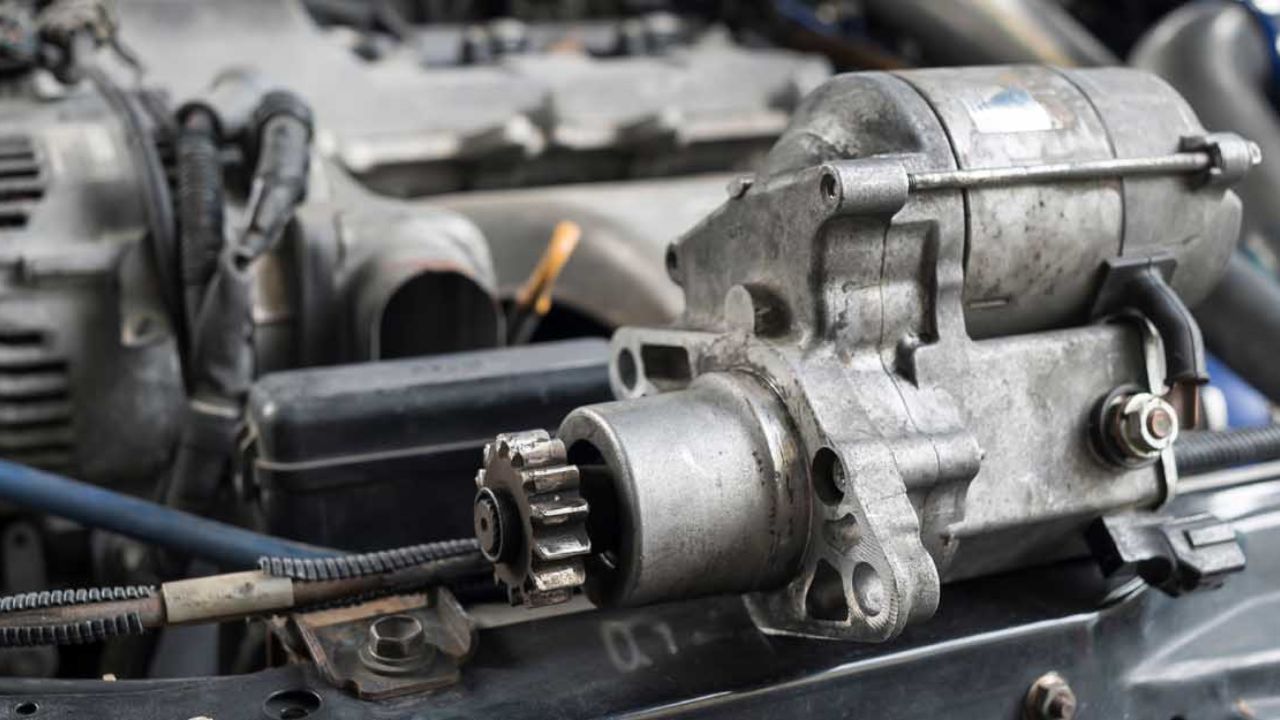
Starter motor function
The starter motor has one core job: deliver high torque for a short time to rotate the engine fast enough for it to start. After ignition and combustion take over, the starter is no longer needed.
Because it draws very high current, a healthy battery and solid electrical connections are essential for reliable starting.
How it works (step-by-step)
The starter system follows a simple chain of events. Understanding this sequence also makes diagnosing “no-start” problems much easier.
- Start command: Turning the key/pressing Start sends a signal through the starter control circuit.
- Solenoid engages: The solenoid energizes and pushes the plunger/rod forward.
- Pinion meshes: The lever fork moves the pinion gear into the flywheel ring gear.
- Motor cranks: Battery power feeds the motor, spinning the pinion, flywheel, crankshaft, and engine internals.
- Engine fires: Combustion begins and the engine accelerates beyond starter speed.
- Disengage: The system retracts the pinion away from the flywheel; the overrunning clutch prevents the engine from driving the starter.
Starter motor parts
These are the major starter motor components and what each one does.
Armature
The armature is the rotating electromagnet assembly mounted on the drive shaft. It’s typically built from a laminated soft iron core wrapped in multiple windings.
Commutator
The commutator is a segmented section of the shaft that the brushes ride on, providing electrical switching to keep the motor turning in one direction.
Brushes
Brushes are conductive contacts that press against the commutator to deliver current to the spinning armature.
Solenoid
The solenoid acts like a heavy-duty switch and actuator. It closes the high-current path from the battery to the starter motor and moves the mechanism that engages the pinion.
Plunger
The plunger moves forward when the solenoid energizes, helping push the pinion into engagement.
Lever fork
The lever fork links the plunger movement to the pinion drive, guiding the pinion into the flywheel teeth.
Pinion
The pinion is the small gear that meshes with the flywheel ring gear to transmit starter torque to the engine.
Field coils (or magnets)
Field coils (or permanent magnets in some designs) create the magnetic field that interacts with the armature to generate torque.
Types of starter motors
Different starter designs exist to match engine size, packaging space, and power demands. Here are the most common types you’ll see referenced.
Direct drive starter motor (DD)
This is a traditional design where the motor’s torque is transmitted more directly to the pinion. It’s common and straightforward, but can be heavier and draw higher current compared to reduction starters in some applications.
Planetary gear (PLGR)
A gear-reduction starter that uses a planetary gearset to multiply torque. These designs can achieve strong cranking power with lower current demand and smaller motor size.
Permanent magnet gear reduction (PMGR)
Uses permanent magnets instead of field coils plus a reduction gearset. Often lighter and efficient, with reduced current draw in many cases.
Permanent magnet direct drive (PMDD)
Similar to direct drive designs, but field coils are replaced with permanent magnets.
Off-set gear reduction (OSGR)
Designed to run at higher speeds with lower current, using gears to increase cranking torque. Common where compact packaging and high torque are needed (including many 4WD applications).
Inertial starter
An electric starter design intended to deliver strong, fast cranking while protecting the motor during engagement, depending on the specific mechanism used.
Symptoms of a bad starter motor
A failing starter can show up in a few classic ways. Some symptoms overlap with battery or wiring problems, so it’s smart to check the battery and terminals first.
- Clicking or whirring noise: You hear clicks or a whirring/grinding sound when trying to start.
- Overheating or burning smell: Excess current draw or prolonged cranking can overheat the starter.
- Dash lights on, no crank: Electronics power up, but the engine doesn’t turn over.
- Hard starting / intermittent cranking: It sometimes starts, sometimes doesn’t.
Starter motor replacement cost
Starter replacement cost depends on the vehicle model, the starter type/brand, and local labour rates. A typical total range is about $200 to $1,200, with labour often ranging from about $140 to $1,000 depending on access and complexity.
FAQs
Is the starter motor the same as the solenoid?
No. The starter motor is the electric motor that provides torque, while the solenoid is the switch/actuator that engages the pinion and sends battery power to the motor.
Why does my car just click when I try to start?
A click can come from the solenoid engaging without enough power to spin the motor. This can be caused by a weak battery, poor connections, or a failing starter.
Why must an automatic be in Park or Neutral to start?
The starter circuit is designed to operate only when the transmission is in Park/Neutral for safety. In a manual, the clutch must typically be pressed so the car can’t lurch forward during cranking.

Post a Comment